I have been a GSI for Phil 2, Individual Morality and Social Justice, three times: in fall 2024, spring 2025, and summer 2026. Each time, my sections worked through a worksheet in small groups every week. I wrote the worksheets in Typst, a typesetting language like LaTeX but much easier to program. Each worksheet was a single file with its answers written into it, and compiling it gave me everything a section needed at once: the worksheet, copies to read from, and the answer key, all laid out identically, line for line.
The worksheets were designed to make a group work together. A section had about fifteen students, whom I split into four groups of three or four. I brought a big bag of colored pens to section, with enough colors that everyone in a group could have one of their own. Each group got a single worksheet to fill in, with a line at the top for each member’s name, written in their color, and I told them I wanted to see the same amount of each color on the page by the end. The worksheet went around the table as the group talked through the reading, and everyone else read along from a shared copy that no one wrote on. When the groups had worked through a box, I led a discussion with the whole section, calling on groups to share their answers and working through the reading with them. At the end of section I collected the filled worksheets, which doubled as attendance, and handed out the answer key.
It was helpful that the GSI gave us the chance to fill out each section within our groups and then slowly explain his thought process on the correct answers referring to lectures and readings.Phil 2, spring 2025
In spring 2025, Jay Wallace, who led the course, gave out study questions for each reading, which picked out the concepts he most wanted students to grasp. Each worksheet opened with the week’s study questions in a box, then took them one or two at a time. Each question headed a box of its own, and inside it was a sketch of the answer as an outline with blanks in it, each blank followed by the page of the reading where its answer could be found. Some boxes asked for something open-ended instead—an original example of each of Susan Wolf’s Blob, Bankrupt, and Useless, say—and left room to write it. So a section kept to what mattered most in each reading, and had students teach it to each other.
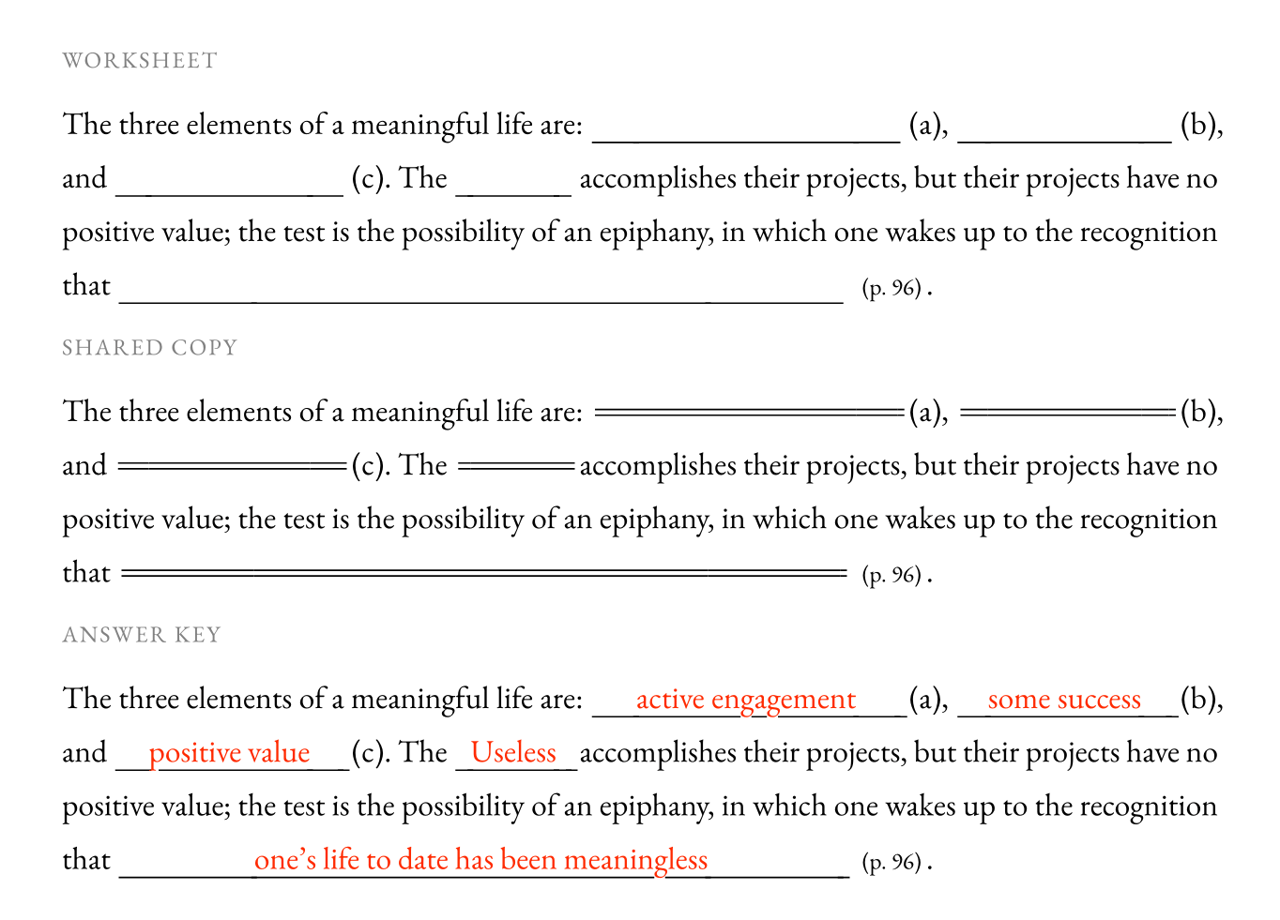
A blank is written with its answer in it: #blank[positive value]. To draw the blank, the template measures the answer, pads it on either side, sets it in transparent ink, and runs an underline beneath it. In the answer key, the same answer is set in red on the same underline. The invisible answer takes up exactly the room the visible one does, so every line breaks in the same place in all three copies, and the key lines up with the worksheet a group handed in. A long blank gives away a long answer.
The padding is three-tenths of the answer’s…
The open-ended boxes work the same way. My own example is in the file, invisible on the worksheet, so the space a group has to write in is exactly as large as what I wrote. In the key it appears in red.
The template typesets the whole worksheet three times in one PDF, changing a single setting between them. The first is the worksheet itself, with the lines for names at the top. The second is the shared copy, with “Please do not write on me!” across the top, SHARED COPY, DO NOT WRITE across each page, and its blanks struck through with a double rule, so there is nothing on it to fill in. The third is the key. How many copies of each to make is a setting too, so a week’s whole stack could go to the printer as one file: a worksheet for each group in each of my sections, a key for every student, and shared copies only for the largest section, since they came back clean and went out again at the next one. Printing each copy only as many times as it was needed saved some paper.
The date at the top is worked out from the week number: the first Monday of the term, a week for each week since, and a week more for each one the sections skipped. Changing the week number is all it takes to start a new worksheet from the last one.
The format works best when the text is clear and there is a clear argument in it to reconstruct. Then the outline of an answer can follow the argument step by step, and the template can number its premises and conclusion.
Students seemed to find it worked. In spring 2025 they rated whether my instructional activities enhanced their learning at 6.7 out of 7, against a department mean of 6.2 for the term.
Filling out the worksheets with multiple people really helped understand the concepts and clarify any questions. … giving out the answers to the worksheets at the end of the class … greatly helped study.Phil 2, fall 2024
By providing the worksheets, Patrick helped me understand what the philosopher was trying to say in a manner that was simple. Not only did they explain what the reading’s intent was but he also provided us with the space to formulate our own examples that increased the overall understanding.Phil 2, spring 2025
Collaborating with other students and filling out the word listing and looking for them in the pages readings was helpful as I could remember it more and get ideas from my peers and also communicate new ideas in general.Phil 2, spring 2025
The GSI provided worksheets that guided students to focus on some of the important elements of the works without giving the specific answer.Phil 2, spring 2025
Small group discussion and work on review questions helps the class gain a deeper understanding of topics, different colored pen system encourages everyone to participate.Phil 2, summer 2026