A local tool of mine, f2palette, makes raw photographs look as if they were shot on film. This is no new idea, but I think the execution is novel. I use FLUX, an image editing model, to imagine what a photograph would look like on, say, Kodak Gold 200. f2palette then fits a lookup table that reproduces that rendering and applies the table to the full-resolution file, so that the edits are applied in full quality.
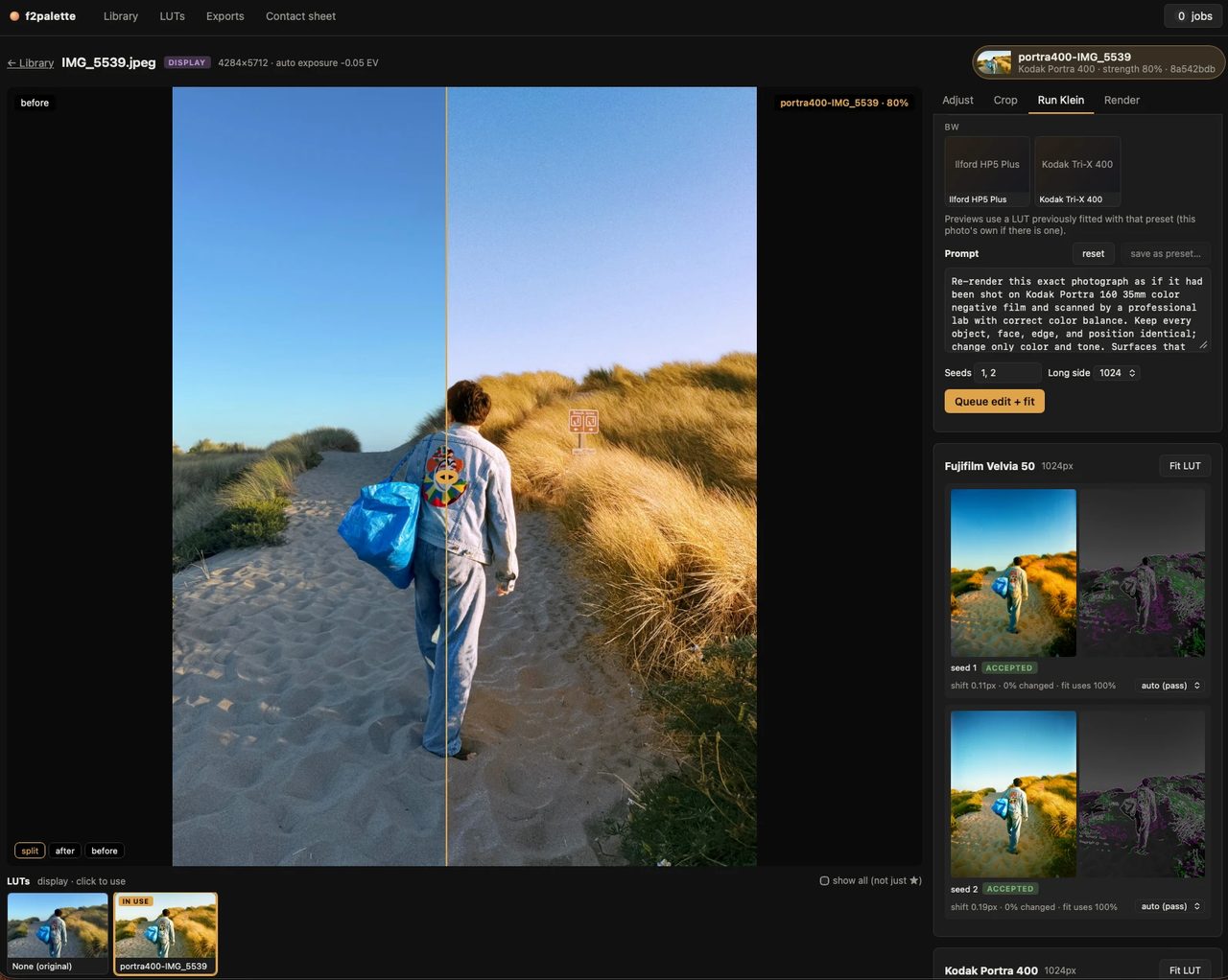
FLUX.2-Klein-9B is quite good at reimagining the general look of a photo, but unreliable at leaving the photograph otherwise intact and unable to edit a 48MP raw file, so it serves only as an oracle. f2palette renders a low-resolution JPG, uses FLUX to generate a few film renderings of the photograph, confirms the photo’s geometry has remained mostly the same, fits a 3D lookup table, or lut, based on the difference between the input and output, and applies the table to the raw file. Each table goes into a library (about eighty so far, most of them CineStill 800T, Portra 400, Velvia 50, or Gold 200) where it can be previewed on other photographs and reused without calling the model again.
luts can be applied at different strengths. Standard controls (exposure, contrast, temperature, saturation, tone curve, etc.) as well as grain and halation are also available.