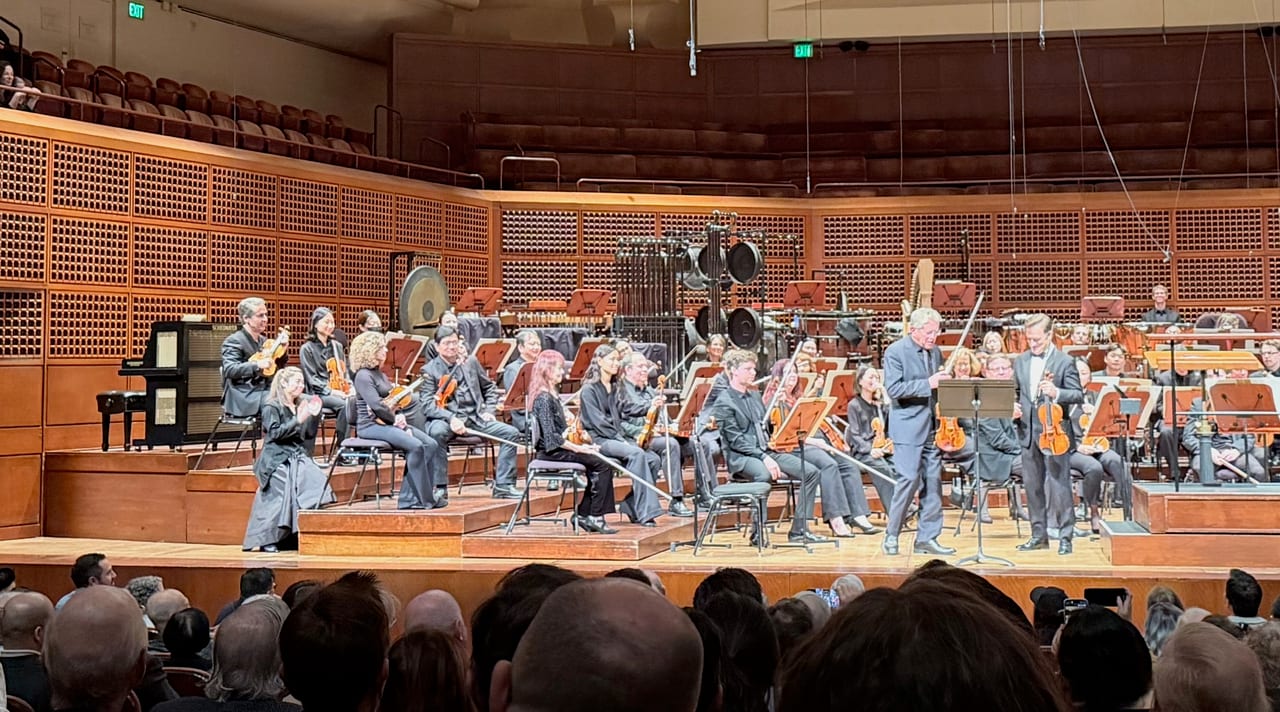
Elim Chan took the stage wearing a violet Valkyries cap: they had won the WNBA finals just minutes before, and Chan was met with raucous cheers. SF is lucky to have a music director designate who loves the city this much already. Josephine and I saw Chan conduct at the BBC Proms in 2023 and were delighted, even in purely musical terms, to learn she had been appointed; it’s an added bonus to have found someone who has built both a musical and personal connection with the symphony and the city (not that the two can be fully separated, anyway).
Opening the program was Brahms’s Nänie, a piece which I did not know existed until I got tickets. Nänie did remind me very strongly, however, of Brahms’s Requiem, which is one of my desert island pieces. Both pieces are blessings for those who have lost loved ones. Nänie ends “Auch ein Klaglied zu sein im Mund der Geliebten, ist herrlich”—“Even a song of grief upon the mouth of the beloved is glorious”; the Requiem begins “Selig sind, die da Leid tragen”—“Blessed are they that bear grief”. And Nänie is replete with the contrapuntal vocal textures that Brahms deploys all over the Requiem. While the stage was being reconfigured for the Mendelssohn, Chan addressed the audience, making the same point that Nänie was a ‘mini Brahms Requiem’, and suggested that the audience keep their ears peeled. I am so excited to hear it performed again! (Did I mention I love the Brahms Requiem?)
Or maybe not: perhaps the space is…
Before this concert, Renaud Capuçon lived in my mind as “Gautier’s brother”, “the other Capuçon”. Having heard just Renaud, I now know this was a disservice. From the opening notes of the Mendelssohn, I was captivated by Capuçon’s tone, which I could only describe as golden. Some violinists have a sound I’d describe as sweet, using vibrato to make notes bloom and sing. The Hahn of recent years, who has lost none of her focus but whose sound has blossomed, comes to mind. Others have a laser-focused tone, paradigmatically Heifetz. (These are of course generalizations about tendencies and taste, not what they essentially are or are capable of.) Capuçon’s individual notes were slightly more burnished than Hahn’s, and cast a slightly warmer, broader light than Heifetz’s, but the result was an expansive lyricism that made the entire first movement feel like just three or four very, very long phrases. Every note spoke with a full-throated voice, whether it belonged to the lyrical opening theme or the descending triplet arpeggios near the end of the exposition. Not once did he seem to struggle to project over the orchestra. I found his golden tone to be the star of the show until the third movement, where I wished he had taken flight a bit more, perhaps finding room for airiness even at the cost of making certain notes have more texture than voice. Perhaps Capuçon had the Midas touch mostly in the modern-day, purely positive sense, but also very slightly in the tragic mythological sense—turning some notes that deserved to be clouds into gold.
The analogy fails here: gold leaf would…
For an encore, Capuçon invited concertmaster Alexander Barantschik to join him for some Bartók duets for two violins. Addressing the audience, Capuçon said that on stage were not only a group of incredible musicians, but two special instruments. Both Capuçon’s own violin and Barantschik’s were made by Guarneri del Gesù. Moreover, Barantschik’s was played by Jascha Heifetz and Capuçon’s by Isaac Stern. They played, I think, three selections from Bartók’s 44 duets (some of which Josephine and I have played, albeit re-arranged for two violas, with me awkwardly re-transposing to manage registers on my violin). Here Capuçon exhibited the airiness I’d hoped for in the third movement of the Mendelssohn—which goes to show, again, that the claims about tone I mentioned above are at very best sweeping generalizations but are more likely based on parochial judgments about particular performances.
After the intermission, the chorus re-entered to perform Arvo Pärt’s Magnificat, which features unaccompanied voices, immediately followed without applause by John Adams’s Doctor Atomic Symphony, an arrangement of scenes from his opera of the same name. From a purely superficial and logistical standpoint, the pairing of the pieces seemed both slightly odd—the chorus would sing without orchestra, then the orchestra would play without chorus, each sitting in silence without the other—and also an illuminating contrast between different figureheads within the ‘minimalist’ tradition, expansively construed. What the pairing actually revealed in concert, however, was a musical form of the question of Brothers Karamazov: if there is no God, is everything permitted?
Roughly four seconds separated the conclusion of the exceedingly beautiful Pärt, the ethereal line Magnificat anima mea Dominum (my soul glorifies the Lord), and the earth-thumping opening of the Adams. In those four seconds, the world made by the music transformed: from one where God scatters the proud in the imagination of their hearts, to one in which man seats himself on the mighty throne, yet finds himself still scattered by nobody but himself. The constant nervous energy present throughout the Doctor Atomic Symphony—whose second movement is literally called Panic—depicts Oppenheimer’s anxiety about his creation of a power beyond humanity.
From the Magnificat: dispersit superbos mente cordis…
The answer to the Karamazov question that I gathered was indirect. If God is dead to us, some will think everything is permitted—but we all will have to live with the consequences, without the blessings of the Nänie to save us.